A Welcome New Figaro
By Tom Washington,
Moscow News №38 2007
Charm, humor and pathos, Mozart's masterpiece has it all. Generally the realm of big companies and big budgets, the smaller Helikon has been brave to compete.
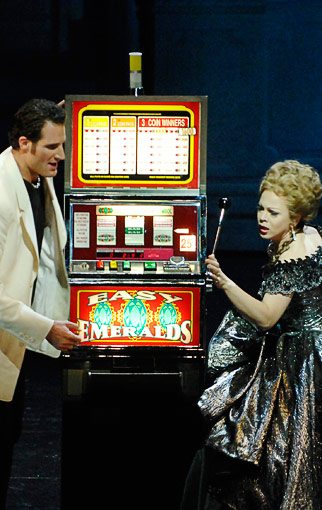
Director Dmitry Bertman has made this performance his own and, true to form, presents a totally unexpected and highly innovative version.
Billed very much as a sequel to their triumphant The Barber of Seville, there were all manner of continuing strands. The characterization of Marcellina, the presentation of the chorus and a synopsis of Rossini's prequel during the overture all echoed Helikon's delightful earlier production. Obviously, time has moved on a bit and many of the characters have too.
The most striking transformation is in Rosina, once the spunky girl wonder who won count Almaviva, she is now the countess Almaviva and a careworn, bedraggled housewife and mother. Usually the countess is portrayed as a noble and sensitive creature who suffers emotionally at the hands of her boorish husband, but is far removed from the drudgery of everyday life. From the moment that Natalia Zagorinskaya walks on with frazzled hair and demanding babies in tow, you see that here the physical trials of life have got to her too, and she is fighting to hold together a difficult marriage. This portrayal negates the need for quite such a lustrous quality of tone in "Porgi Amor" and "Dove Sono". The more metallic and grainier sound of this countess is thus excused, you forgive much of a woman who preserves her dignity and poise in the face of lost youth and material comforts, and a grisly marital deal.
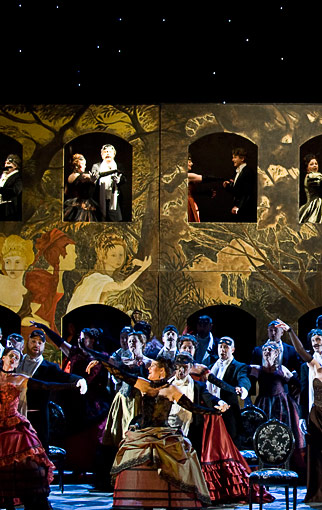
This leads to another twist in Bertman's representation of the Almaviva marriage, they are broke. The castle is up for sale and is deteriorating along with its proprietors' relationship. A real low point comes when Almaviva sets fire to the whole place, along with its beleagured occupants. Bertman's scene setting and staging is impeccable to the last, and the final garden scene plunges the audience straight into the action, amid the confusion of the plot's denouement.
The shining star of Bertman's vision and interpretation is Anna Grechishkina's Susanna. Her crystal clear soprano shines through the mélange of sound like a bell (despite being still quite a light voice,) and her acting is top class. A very generous performer who does not consciously steal the limelight, she nevertheless radiates the warmth and energy of Mozart's greatest character. Quite a challenge to stand out when her colleagues are also talented and highly cultivated comic actors.
Grechishkina's is the only voice I would single out for lavish praise. Stanislav Shvets was a personable Figaro, but disappointing vocally. There was scant sense of phrasing and little of the role's sparkling musicality came through. Igor Tarasov's count was less than ideal too, as his tuning let him down. He nevertheless conveyed a characterful and suitably malevolent Almaviva.
Denis Kirpanev directed the music, and I do wonder how much of the singing deficiencies could be laid at his door. Although he conducted very clearly, and was lambently clear in communicating his wishes to the orchestra there was (as with Shvets) little sense of phrasing and they sounded under-rehearsed.
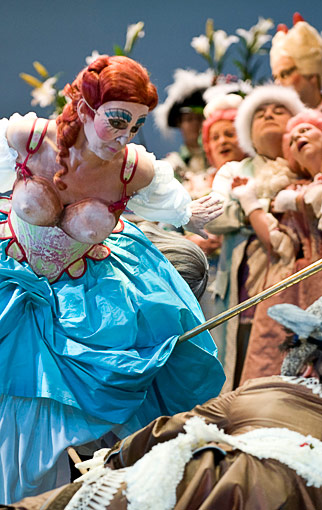
Aiding and abetting Bertman is Yury Ustyugov, who directed stage movement and choreography, and Damir Ismagilov on lights. They worked wonders in supporting Bertman's vision of the opera, and the cast's slick actions were highlighted with the deftest of touches. Igor Nezhny and Tatiana Tulubieva have created wonderful costumes, from Susanna's dreadlocks to the countess's worn rags. They were as individualistic and vibrant as the rest of the production.
A truly original vision of Figaro, Bertman has taken something which has been done time and again and created an entirely fresh piece. He has navigated budgetary constraints and mustered some stellar performances from his Helikon team. A few musical problems there might have been, but short of importing expensive stars it is hard to see how these could be avoided.

© 2008-2011 Dmitry Bertman
Developed by Dillix Media Group