Helikon Has a Hit With "Love for Three Oranges"
By Raymond Stults,
The Moscow Times
Things started off badly the evening that I visited Helikon Opera for a look at its new production of Sergei Prokofiev's "The Love for Three Oranges". Assigned a seat at the very end of the first row, I found myself sitting cheek by jowl with the orchestra's trombones, tuba and percussion section, hardly the spot, it seemed, to hear much from the rest of the orchestra or from the voices on stage.
I also feared that Helikon's artistic director Dmitry Bertman might find the absurd story of Prokofiev's opera a perfect excuse for loading the stage with the sort of gimmicks that have frequently defaced his forays into operatic comedy.
But I ended up leaving Helikon in a very positive frame of mind. Playing at high volume, the adjacent instruments did indeed obscure almost everything else that was happening musically. But those blasts of sound mercifully occurred only at rare moments. And Bertman's staging, far from being gimmick-ridden, turned out to be an almost minimalist effort that served Prokofiev's libretto and music better than any version of the opera that I have ever seen in the past.
"The Love for Three Oranges" occupies a special place in my affections. Other than it, not many operas of note have made their very first appearance in my native city of Chicago. And in the same city, nearly three decades after its premiere there in 1921, it served as the vehicle for my own, no doubt completely unnoticed, debut on the operatic stage, in the brief nonsinging role of a drunkard.
To tell the truth, however, I long held "The Love for Three Oranges" in low regard, thinking its score rather thin and its story totally ridiculous, even by operatic standards. Only with the Bolshoi Theater's production of 1997, staged by the great playwright and actor Peter Ustinov, and the Mariinsky Theater's excellent version that visited Moscow two years ago, did I find myself warming to it. And now, with a Helikon production superior in many respects to either of those, I find myself finally convinced that it deserves to be considered one of the true masterpieces of the 20th century's greatest master of Russian opera.
Prokofiev himself wrote the opera's libretto, basing it on a theatrical fairy tale by the 18th-century Italian playwright Carlo Gozzi. Its tangled tale of a battle between good and evil centers on a somewhat simple-minded prince, heir to an imaginary kingdom, who is first wrenched from a state of paralyzing melancholy and then, as the result of a curse, sent on his way in search of a certain carefully guarded trio of magical oranges. In the end, he carries off the oranges and is victoriously united in love with one of the charming princesses whom he discovers hidden away inside the fruits.
One early critic insightfully described "The Love for Three Oranges" as the first entirely theatrical Russian opera. As such, it absolutely demands to be both heard and seen. Apart from its famous march, there is nothing in the opera's music that can really stand alone. Yet with its skipping and scampering about, the orchestral score neatly matches both the twists and turns of the story and a vocal line that seems mostly a musical mimicking of normal speech.
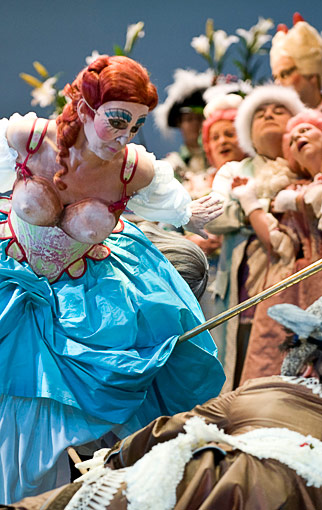
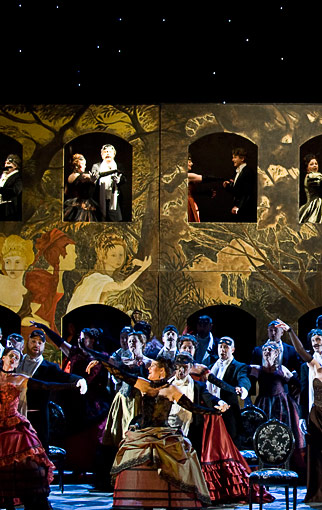
Helikon house designers Igor Nezhny and Tatyana Tulubyeva have provided the new production with a simple box set, decorated in orange and black, and instead of cluttering the stage with their usual surfeit of "visual noise," they have left the playing area bare, except for a pair of steamer trunks that effectively serve a variety of purposes, among them as tables, chairs and hiding places, and an impromptu kitchen where the magical oranges are stored.
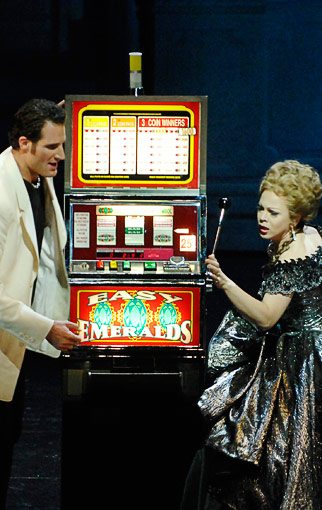
Bertman's telling of the opera's story could well be taken as a parable of modern Russia, the king seeming not unlike a wealthy oligarch, surrounded by henchmen and beset by enemies, the prince portrayed as his overindulged spoiled brat. Avoiding slapstick and any temptation to produce cheap laughs, Bertman gives the opera a reading of insight and restraint that very much fits the spirit of Prokofiev's words and music, while never for a moment losing interest.
Helikon fielded a very strong cast at the performance that I attended. Of particular note was tenor Vadim Zaplechny, who not only played the court jester Truffaldino with great cunning, but brought real vocal weight to a role usually entrusted to much less gifted singers. Conductor Denis Kipranyov, substituting for Helikon musical director Vladimir Ponkin, led the score with appropriate briskness and brought into focus a fair number of details that I don't recall ever having noted before.

© 2008-2011 Dmitry Bertman
Developed by Dillix Media Group