Moving mermaid
Dvorak's opera Rusalka, a version of The Little Mermaid, gets a splashy production
By Jon Kaplan,
NOW
Though Dvorak's best-known opera, Rusalka, is a take on The Little Mermaid, don't look for any Disney-fication of what's basically a tragic tale.
The water nymph Rusalka falls for a prince – he doesn't know she's the wave caressing him when he goes swimming – and wants to be human to share his love. With the help of the witch Jezibaba, she takes on human form but loses her voice as payment. When a foreign princess enters the picture, things don't go as Rusalka's planned; she finds herself caught uncomfortably between the realms of nature and human beings.
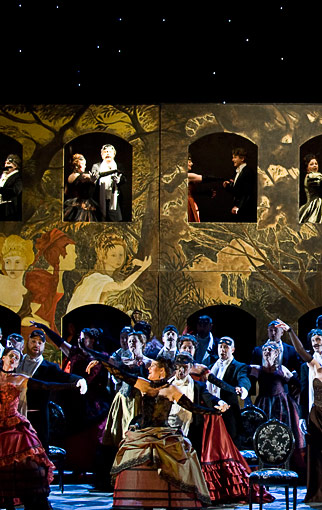
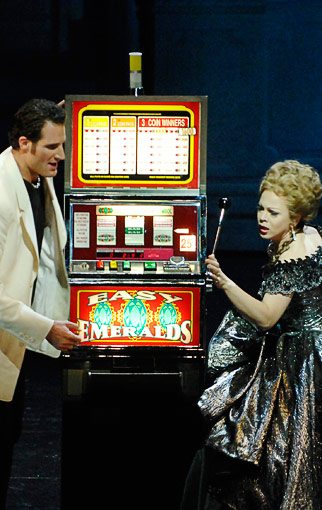
Director Dmitri Bertman, who's previously helmed some bizarre productions for the Canadian Opera Company, delivers a moving, involving evening that flirts with fairy tales but is grounded in the modern world.
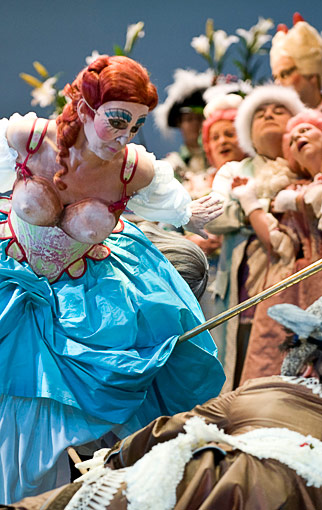
He gets great support from set designer Hartmut Schörghofer, whose turntable set, lit by Thomas C. Hase, gives us an expansive lake with huge water lilies (and real water), giant fireflies, lots of goldfish bowls and a boxed-in world for the prince's court. Corinna Crome's costumes are as much fun, especially Jezibaba's red house and lizard-like garb.
Conductor John Keenan draws lush sounds from the orchestra, especially the string section; sometimes, though, he drowns out Julie Makerov, a mostly tender Rusalka, notably in the opera's most famous number, the song to the moon. The plot dictates that she doesn't speak for parts of the first two acts; it's too bad that she and Bertman couldn't find a way for Rusalka to be physically communicative during that time.
There's fine work, too, from the commanding Irina Mishura as the witch, a seductive, big-voiced manipulator who's imagistically tied to the rival princess (Joni Henson), and dark-voiced Richard Paul Fink as the water gnome who warns Rusalka about leaving the natural world.
Michael Schade's prince, though well and passionately sung, doesn't offer much drama to the tale. But Michael Barrett and Betty Allison, as a couple who break the narrative's fourth wall in an unexpected fashion, prove that in the right hands minor comic roles can become a major part of the story.

© 2008-2011 Dmitry Bertman
Developed by Dillix Media Group