Rethinking Figaro
By Raymond Stults,
The Moscow Times
Dmitry Bertman adds deft comic touches and lyrical magic in Helikon Opera's new "Marriage of Figaro".
Much in fear of what might lie ahead, I made my way to Helikon Opera last week to see a preview performance of Wolfgang Amadeus Mozart's "The Marriage of Figaro". The new production is the second installment of a project by the company to present operas based on all three Figaro plays by 18th-century French writer Pierre-Augustin Caron de Beaumarchais.
The first in the series, Gioacchino Rossini's "The Barber of Seville", appeared in June. Sadly, director Dmitry Bertman buried both music and words under a load of largely pointless gags and gimmicks.
I rather expected, before the curtain rose last week, that Bertman would do similar damage to what is almost certainly the supreme masterpiece of comic opera and possibly of opera in general. Also on my mind were memories of the appalling pseudo-rock version of "Figaro" perpetrated last spring at the Golden Mask festival by Yekaterinburg's Theater of Musical Comedy.
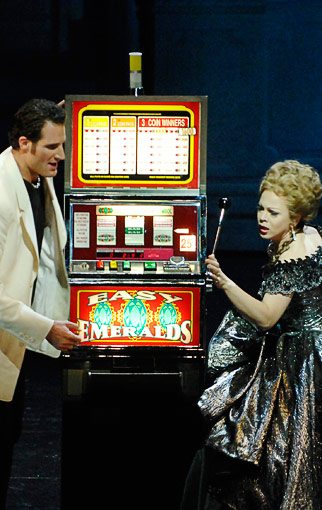
But happily for all concerned, Bertman has this time taken a different tack. Instead of doing something novel simply for the sake of novelty, as seemed the case with the hapless "Barber," this time he has done something novel that brings much in the way of fresh insight and illumination and does no serious damage to either Mozart's score or the masterful libretto of Lorenzo da Ponte.
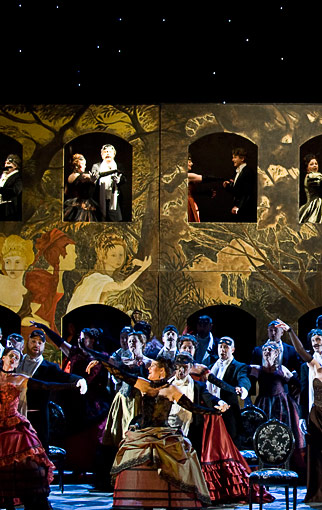
Unlike the clutter on stage that spoiled the "Barber", the sets created for "Figaro" by Helikon house designers Igor Nezhny and Tatyana Tulubyeva leave plenty of acting space. The backdrop is a beautiful photographic scene of forest and hills. Center stage holds a miniature version of the aristocratic Almaviva's family castle that revolves to display a sadly rundown interior and a faНade adorned with a "For Sale" sign. The castle goes up in flames at the end of the second act, and the third act is played among its ruins. It then reappears, perfectly restored, at the very end.
One magical touch is Bertman's decision to play the confused-identity scene of the fourth act in the darkened aisles of the auditorium rather than in its usual garden setting on stage. During the scene, a few audience members even find themselves pulled into the action. The result is fun of a sort that the mischievous Mozart would probably have much appreciated.
Missing from Bertman's concept, however, is any real sense of the biting social commentary in Beaumarchai's play. The author took aim at French society in the era of Louis XVI, (although he cautiously set the action in Spain) and da Ponte carried this over to his libretto. Brushing aside the master-servant conflict between Figaro and Count Almaviva, Bertman seems to be more interested in showing the inner workings of a thoroughly dysfunctional household.
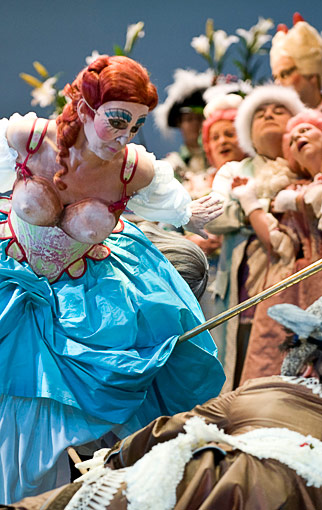
Bertman turns the usually soignОe Countess Almaviva into a middle-aged hag with a sore back and a headache, while the maid Susanna comes across as something of a trollop. He also points out a certain sexual ambiguity in the character of the pageboy Cherubino (a role written to be performed by a female mezzo-soprano). Some justification can probably be found in the libretto for these characterizations, and for the most part, they seemed appropriate.
Among the few dubious points in Bertman's staging is the rather silly way he emphasizes Cherubino's immaturity, introducing the pageboy in a stroller, dressed in baby pajamas and sucking an outsized pacifier. When Cherubino puts on female clothes as a disguise, this is performed like a striptease, revealing the female body of the performer all too clearly.
As usual, Bertman has gone all-out with multiple casting, assigning as many as seven singers to a single role. Those heard at last week's preview proved a mixed bag. Best of all was Helikon's long-time leading soprano, Natalya Zagorinskaya, who gave a passionate performance as the unhappy Countess. She sang throughout with a fine sense of Mozartean style and gave a particularly exquisite account of her great third-act aria, "Dove sono".
In the title role, bass Stanislav Shvets – who has already carved out a notable career on major operatic stages abroad – delivered eloquent and stylistically informed singing, as well as fine acting. Soprano Anna Grechishkina gave a delightfully sexy performance as Susanna, particularly when she helped the Count undress in preparation for the exercise of his signeurial jus primae noctis. Mezzo-soprano Alisa Gitsba was also outstanding as the housekeeper Marcellina; fortunately, she was allowed the role's usually omitted fourth-act aria.
The preview found Helikon's orchestra on its best behavior. Nevertheless, it didn't come close to matching the stylish orchestral playing at the Stanislavsky and Nemirovich-Danchenko Musical Theater's production of another Mozart-da Ponte opera, "Cosi fan tutte", which won three Golden Mask awards this year.
The third installment in Helikon's series of "Figaro" operas will be French composer Jules Massenet's rarely performed opera "Cherubin",based on the final play of Beaumarchais' trilogy, "The Guilty Mother". The production will probably premiere next season.

© 2008-2011 Dmitry Bertman
Developed by Dillix Media Group