Rusalka
By Christopher Hoile,
Eyeweekly
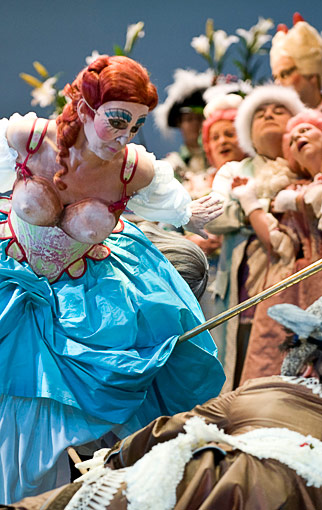
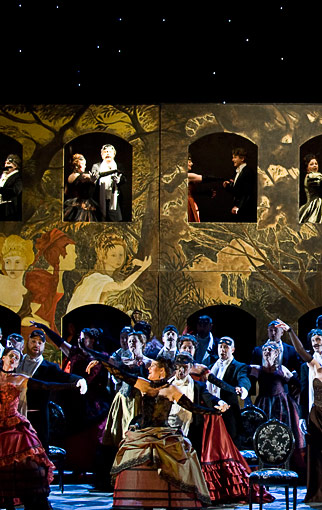
Many Czechs regard Dvorák's finest opera Rusalka (1901) as the Czech opera bar none. Its combination of fantasy and infinite sadness, based on Hans Christian Andersen's "The Little Mermaid", somehow reflects the national soul. This is why Richard Bradshaw, when General Director of the COC, promised the Czech-born Nicholas Goldschmidt, co-founder of the COC, that the company would stage this, his favourite opera, in honour of his 100th birthday. Sadly, neither man is now with us. Conductor John Keenan brings out all the lush beauty of the score. Hartmut Schörghofer's ingenious revolving set well suits an opera that alternates between the worlds of fantasy and reality, and Corinna Crome's costumes are full of whimsy. If only director Dmitri Bertman could form all these elements into a satisfying whole.
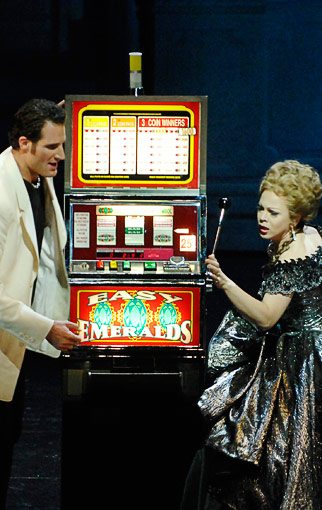
As Rusalka, the water spirit who yearns to be human, Julie Makarov sings with great nobility of tone. Her characterization is too generalized in the first two acts, but in the third, when Rusalka has become resigned to her dreadful fate, Makakov blossoms magnificently. Bertman has Michael Schade depict the Prince Rusalka loves as dissipated from the very start, thus making Rusalka's love look foolish. Their love should last until halfway into the second act when the Foreign Princess (a steely Joni Henson) schemes Rusalka's downfall. In Bertman's version the Prince has already tired of Rusalka within a week which makes nonsense of his desire to marry her. In a better production all the festive music of the court scenes can be used to depict the court's disapproval of the Prince's bride and the effect of this attitude on the Prince, a point Bertman almost entirely misses. Bertman sees the image of a fishbowl as a potent metaphor, since Rusalka trades one confining environment for another, but Bertman overuses the image ad nauseam.
The production does have its wonders, such as the entrance of the wood nymphs on flying water-beetles or Bertman's reinterpretation of Dvorák's comic peasants as arguing audience members. Irina Mishura is deliciously supercilious as the witch Je?ibaba, and Richard Paul Fink is richly authoritative as the Water Gnome, Rusalka's despairing father. Directed with more sensitivity, the conclusion of the opera can be overwhelmingly poignant. We are very fortunate that the COC has honoured Richard Bradshaw's promise and allowed us, at last, to hear this masterpiece. It is just too bad Bertman could not bring out all the promise of the opera itself.

© 2008-2011 Dmitry Bertman
Developed by Dillix Media Group