This fairy tale sings despite staging missteps
Robert Everett-Green,
globeandmail.com
Dvorak thought of himself mainly as an opera composer, and spent the last busy decade of his life writing only for the stage. Yet many fans of his symphonies and chamber music know only one little bit from his 11 operas: Rusalka's Aria to the Moon.
Rusalka is the only Dvorak opera to have legs outside Czechoslovakia, and must have been in the long-term plans of the two Czech immigrants (Nicholas Goldschmidt and Arnold Walter) who helped found the Canadian Opera Company. Sixty years later, the opera finally arrived on the stage of the company's Four Seasons Centre.
Rusalka is a "lyric fairy tale" about a water nymph who falls in love with a princely hunter who sometimes swims in her pond. She convinces a witch (Jezibaba) to make her sufficiently human to pursue him. The transformation is not reversible, and doesn't give Rusalka the power of human speech.
That last detail is one reason why Rusalka hasn't held the stage as strongly as it might. The heroine stays mute for about half the show, and doesn't sing with her prince till the very last scene.
Nonetheless, it's well worth hearing for its rich melodic score, and even for the many echoes it contains of other fairy-tale operas by other hands. The mysterious Rusalka and her baffled boyfriend are cousins of Debussy's Mélisande and Golaud, Rusalka's sister nymphs act a lot like Rhinemaidens, and Wagnerian motifs (including a six-chord sequence I think of as the "hard truths" motif) bubble up frequently.
The COC's production, rented from Theater Erfurt in Germany, features a strong cast and a recklessly imaginative staging. Tenor Michael Schade's bright, clear tone and intelligent phrasing told us things about the Prince that his rather stolid physical presence could not. Julie Makerov was better at portraying Rusalka's fearful yearning than I would have expected after her passive turn as Donna Elvira in last fall's Don Giovanni. Her warm soprano bloomed beautifully at many crucial moments.
Mezzo-soprano Irina Mishura played Jezibaba as a powerfully sensuous creature with a voice to match. She ruled the stage whenever she appeared, and not just when she had the water gnome Vodnik (sung by the superb character baritone Richard Paul Fink) twitching at the end of her fishhook.
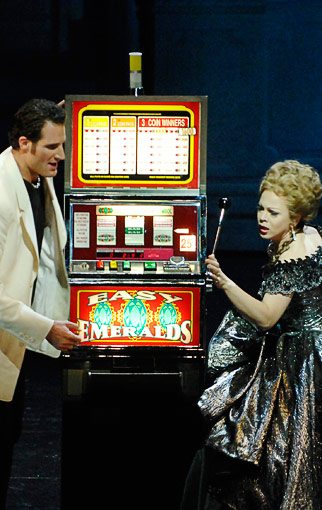
Yes, the witch in this production is an angler, and a schemer, and a bawd, all of which might have surprised Dvorak and librettist Jaroslav Kvapil. Director Dmitri Bertman even puts Jezibaba directly in charge of Rusalka's humiliation by the malicious Foreign Princess (dramatic soprano Joni Henson, who sounds more commanding with every appearance).
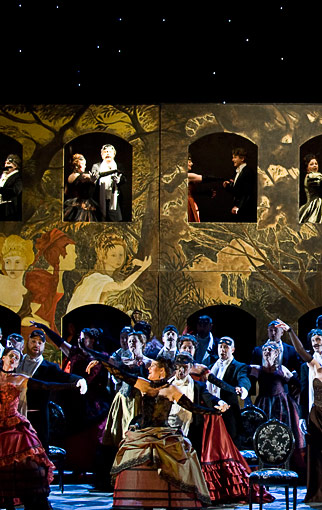
The witch's comment about the rootlessness of humankind also seems to have influenced Hartmut Schorghofer's carousel stage set, which abounded in greenery and water on one side (astutely lit by Thomas C. Hase), and put the Prince in a cold, colourless world on the other. I got very tired of this carousel during the ballet, when it made four slow pirouettes that failed to shake my belief that a ballet should include dancing.
Bertman has a way of fetishizing props (a conch shell, a white necklace, the Prince's bed) that actually limits their effectiveness as visual symbols. He's also inclined to push a good idea too far, as he did when a clever piece of staging for the Gamekeeper (tenor Michael Barrett) and Turnspit (soprano Betty Allison) became pointlessly farcical the second time round. And did we really need to have Schade blunder in and lie on his back during Rusalka's famous appeal to the moon?
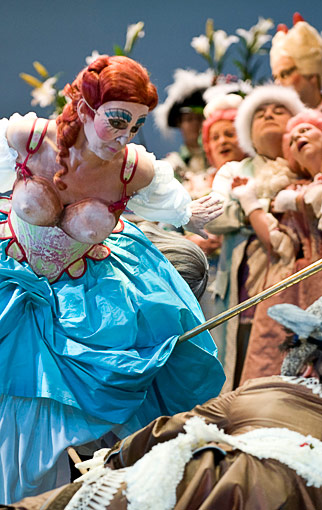
Corinna Crome's costuming was austere for the Prince and chorus (black and white evening wear), wildly exuberant for almost everyone else. Jezibaba wore a sparkly crimson dress slit up to the thigh, Vodnik looked like an especially flamboyant hippie, and the three wood nymphs (Teiya Kasahara, Lisa DiMaria and Erin Fisher) were well on their way to becoming insects. Two of them descended on giant flies, surely this show's most spectacular effect.
But there were many times when I found it best to focus on the assured, lyrical sounds coming from cast, chorus and orchestra, all of which were eloquently led by conductor John Keenan. Rusalka is about giving up too much of your true self in pursuit of your dream, but these performers always held on to the best of what they had to offer, even when the dream on stage went awry.
Rusalka continues at the Four Seasons Centre through Feb. 23.

© 2008-2011 Dmitry Bertman
Developed by Dillix Media Group