Up close and controversial
By Shaun Walker,
Russia Profile
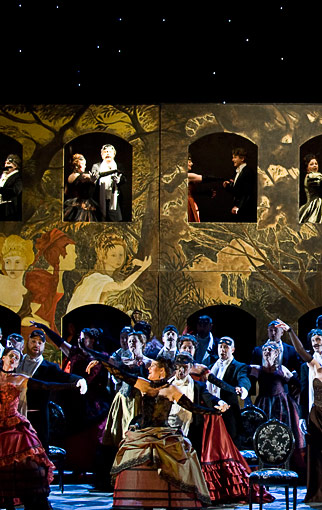
On Moscow's Bolshaya Nikitskaya Ulitsa sits the Helikon-Opera, perhaps the most unusual of the city's establishmed opera stages. Despite long plans to move to bigger auditorium, the company still crams its productions into the tiny 18th century building that was previously an aristocratic residence. The auditorium holds less than 300 spectators, and the space seems more appropriate for string quartets than full-scale operas. For the less popular shows, there are sometimes more performers than spectators. The small size of the theatre means that the Helikon is one of the few in the world where tickets in the front row are the cheapest, with the most expensive seats right at the back – anyone sitting in the front row runs the risk of having an eye gouged out y an overenthusiastic first violinist. The cheap tickets are not pricier than visiting the cinema, and even the most expensive seats rarely top 700 roubles, which for a three hour fully staged opera represents one of the Moscow's best cultural bargains. Although the small stage gives rise to obvious technical limitations, being so close to the action and the source of the sound creates an experience much more arresting and engaging than what is possible in cavernously large traditional opera houses.
The Helikon's significance on Moscow opera scene is well out of proportion to its size. The repertoire is made up of well-known operatic classics given usual twists, with the addition of some works heard less often. The focus is on the 20th century, with the current season including performances of operas by Dmitry Shostakovich, Francis Poulenc, Alban Berg and Leos Janacek, as well as Fallen from the Sky, described as "The Helikon's tribute to the sacrifices made during the Great Patriotic War" created using excerpts from two different works by Sergey Prokofiev.
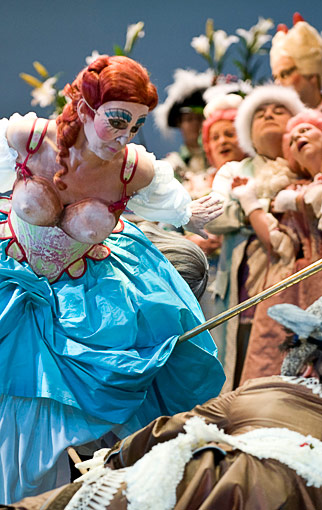
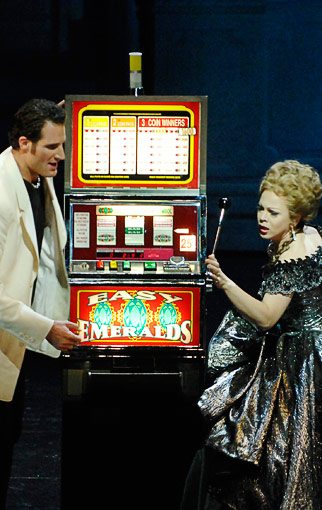
Despite the limited resources with which the theater is compelled to work, the seats created in the cramped conditions are impressively creative, not to mention controversial – in Poulenc's Les Dialogues, the Carmelite nuns have their heads shaved on stage, before being bowled to death, using ten pin bowling balls; the rape scene in Schostakovich's Lady Macbeth of Mtsensk is accompanied by a messy simulated ejacuation; Carmen is a prostitute who has most of her encounters in the back of a burnt-out Lada. Some of the Duma deputies who so vehemently decried Leonid Desyatnikov's Children of Rosenthal at the Bolshoi Theater as "pornographic" would quite possible have heart attacks if they saw some of what the Helikon has produced over the years. In addition to its full length repertoire, the "Opera Café" is a series of 40 minutes short operatic pieces – the auditorium is filled with tables, at which audience members sit and are served beer or coffee and cakes by the cast members during the course of the performance.
The name of Dmitry Bertman is as synonymous with the Helikon as Valery Gergiev's is with Mariinsky. Only 23 when the company was founded in 1990, Bertman has been the artistic director ever since, personally responsible for the unusual repertoire choices and adventurous sets that have given the Helikon its reputation. Bertman's methods, especially the way in which some of the Helikon productions chop and change scores and storylines – for example , The Helikon's Carmen has different ending from Bizet's original – have earned some criticism both in Russia and the West, where the company frequently tours. But there is no doubt that for many years the helicon provided the only forum in Russia for those interested in 20th-century opera, and Moscow's main alternative to the stiflingly traditional performances of the Bolshoi.
The changing landscape of Russian opera is demonstrated by the fact that on Oct. 22, Bertman's production of Guiseppe Verdi's Nabucco with the stage replete with oil rigs, premiered at the Mariinsky Theater under Gergiev's baton. The bad boy of Russian opera has gone mainstream – a sing both of the maturing of Bertman and the Helikon, and of a new openness to innovation in the traditional opera theatres.

© 2008-2011 Dmitry Bertman
Developed by Dillix Media Group