What a fish out of water learns from experience
By John Keillor,
National Post
In opera, plot-pushing symbolism is a hit-and-miss affair, whether attempting to reveal the Masonic codes in Mozart's The Magic Flute, or playing down the disturbing theological pretensions of Wagner's Parsifal. In either case, the props and sets often allude to historical footnotes that baffle and alienate broader audiences.
Dmitri Bertman's staging of Dvorak's Rusalka for the Canadian Opera Company overcomes this problem by literally drawing a line between fantasy and reality as it plays out onstage. It begins with the sensual overture: a thin blue line, slowly rising from the bottom of the curtain to the top. Rusalka is a water-nymph who crosses over from her spirit world to ours so she can love a human prince, much like in Hans Christian Andersen's The Little Mermaid. Her impulsive decision has tragic implications that are illustrated with visual transitions from colourful, woodsy innocence to achromatic, civilized experience.
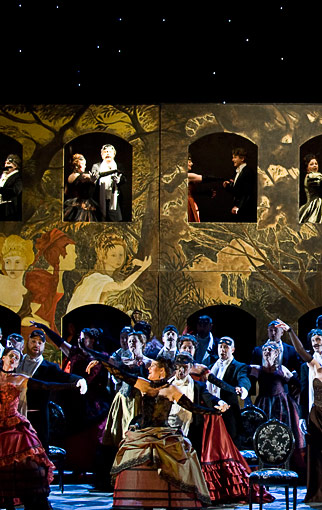
Set designer Hartmut Schorghofer's adaptation uses translucent screens, a water-filled pond and a huge rotating set to get these points across, which are always folding together in new, arresting ways that could hold their own as abstract visual art.
However, the first thing one will notice is how familiar Dvorak's music seems, even though Rusalka is rarely performed in Canada. The 1901 score is lyrically sumptuous and harmonically straightforward, with wind-heavy orchestration and arabesque melodies that conductor John Keenan illuminates as robustly as Bertman's realization of the setting.
And all the singing is equal to its accompaniment: Soprano Julie Makerov's Rusalka is heartbreaking as a wilful young forest spirit dazzled by the beauty of tenor Michael Schade's oblivious prince, whose black and white world is blind to hopeful supernatural lovers. Her father, baritone Richard Paul Fink's water gnome, patiently explains to her how pursuing this prince will lead to a sterile, geometric world she cannot survive in.
Undeterred, Rusalka gets help from a witch, mezzo Irina Mishura's Jezibaba, who lives in a coffin-like red arrow pointing upwards. She casts a spell to make the young sprite mortal, while warning her that if her lover is ever unfaithful to her, they will both be damned. Also, Rusalka will lose the ability to speak while in human form.
The prince finds the transformed Rusalka while hunting, and immediately falls in love with her. But soon Schade's credulous prince is getting bored of his mute wife, and the interloping Jezibaba seduces the naive aristocrat, dooming the couple.
Mishura's Jezibaba is a deliciously wicked villain, flirtatious and corrupt, singing with commanding vampiric gusto. She's the antipode to Fink's retiring phantom father character, who will only advise his daughter but never force his judgment upon her. Schade and Makerov, when their characters finally sing together, generate a romantic heat worthy of Tristan and Isolde.
But the really striking element to this emotional quagmire is how Jezibaba is not just a baddie. She is a manifestation of fate. And fate, as it turns out, is an interested party. We are all doomed to gain experience and to be deprived of our innocence. That process is painful, as Rusalka discovers when she loses her voice, her immortality and her sisters (who hate her for leaving them). She doesn't even get to keep the guy she gave everything up for, and she can't go back. Experience cannot be recanted. Jezibaba has a sinister appetite for her work, but she is not evil. She is inevitable. Her red arrow domicile points in one direction, the way fate does. That's life.
Symbols like this one accrue more and more meaning throughout the production. When Rusalka's father cautions her about impetuous love, for example, he uses a goldfish in a clear bowl to represent attraction. Later, when the prince is vulnerable to Jezibaba's advances, the set rolls back for a moment, and we see the father again, sadly pouring water out from a goldfish's bowl - the pleasures of innocence being lost.
Bertman takes a rather simple story and injects it with Fellini-like significance that doesn't slow down the action or dampen the drama as Rusalka rides the line between purity and desire.
Many opera plots thrive on the complications surrounding love. Here, Bertman makes love subordinate to destiny. This fascinating manoeuvre constitutes a real adult theme. If you don't go to the opera because love stories are just too similar most of the time, then this is the show for you. The director is interested in how the same sort of romantic problems pass themselves on from generation to generation. Bertman allows us to view the mechanics of our eternal erotic tragedy. The fresh and seamless execution of this production makes it absolutely necessary viewing for opera veterans and newbies alike. Rusalka continues at the Four Seasons Centre, Feb. 5, 11, 17, 20, 23 at 7:30 p. m.; Feb. 8 at 2 p. m.; Feb. 14 at 4 p. m. For tickets and details, visit coc.ca.

© 2008-2011 Dmitry Bertman
Developed by Dillix Media Group